01 / Target acquisition
57/100
Target switching 25%
Evaluates rapid movement to a target using movement time, path and corrections. A score of 57/100 indicates an area for calm, focused practice.
 v1.3.8
Aim control diagnostics for FPS players
It does more than display a score. It separates aim control, reaction, recoil and measurement quality, then explains what to practise, what to keep unchanged and when to run a comparable retest.
Coming soon
FPS Performance Lab is undergoing final verification before its public release. We are checking measurement repeatability, recommendation clarity, report generation and installation so the first official version is consistent and ready for everyday training.
The release date will be announced after quality testing is complete. Until then, this website presents real features and the current direction of application development.
Explore the application scopeApplication update · 1.3.8 closed test
The latest build improves measurement quality and support for different configurations without changing the core process: test, interpretation, training and a comparable retest.
Real report from 14 July 2026
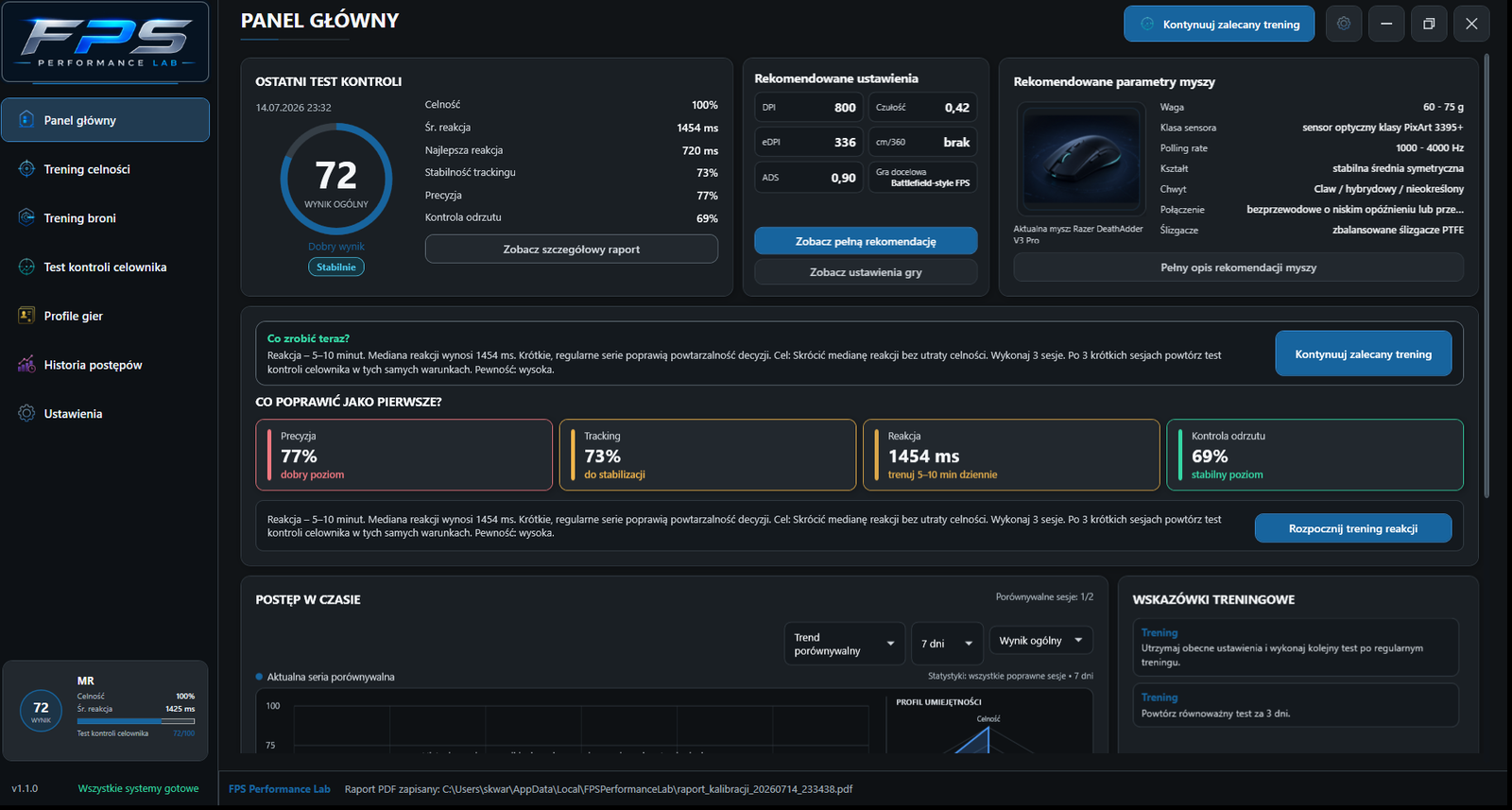
ControlIndex is not a single accuracy or reaction-time measurement. It combines four aim-control areas using the weights shown in the report. In this test, the weighted sum was 71.85 points, so the report displays 72/100.
Evaluates rapid movement to a target using movement time, path and corrections. A score of 57/100 indicates an area for calm, focused practice.
Describes the ability to decelerate and finish close to the target centre. This well-developed area stabilises rapid target switching.
Combines smooth and reactive tracking: time on target, proximity, jitter, continuity and target recovery. The area is functional but loses stability in more difficult trials.
Checks consistency across consecutive blocks and late-test decline. This is the strongest measurement pillar: consistent execution increases the value of a later retest.
Supplementary scores
The report shows them separately so reaction speed and burst control are not mixed into the main aim-movement score. A low supplementary score is therefore not mistaken for missing data or an automatic cause of the 72 result.
Reaction · outside ControlIndex
The median was 1454 ms across 20 valid trials with no premature clicks. The upper threshold of the descriptive scale is 650 ms, so 1454 ms produces 0/100. This is a measured result, not missing data.
Conclusion: practise noticing the target and initiating movement decisively; do not increase sensitivity for this purpose.
Recoil control · outside ControlIndex
The analysis covered 3 series and 195 shots. Compensation is functional, but spread increases during a longer series, so the application recommends stabilising control rather than radically changing settings.
Conclusion: reinforce shorter controlled bursts and compare grouping under the same conditions.
Data quality first
Yes, with a minor warning. The application separates skill assessment from measurement quality, checks trial completeness and interference, and only then forms a conclusion.
The pointer left the test area twice. Active-window loss: 0; timer interruptions: 0. The warning remains visible but is not a penalty deducted from the main score.
From measurement to decision
Scroll through the stages. The preview changes to a real application screen, while the description explains each module's role in the diagnostic cycle.
Dashboard top: latest test, settings, mouse parameters and current training priority.
The dashboard is taller than one window. Its upper part combines ControlIndex, recommended settings, mouse parameters and training priority; below it shows the trend, skill profile, guidance and recent activity.
Supports reaction, flick, tracking and precision. The user sets difficulty, round time, target size and tracking speed.
Local fictional profiles describe RPM, magazine size, ADS, recoil, recovery and spread. The module does not connect to a game process.
Filters, session metrics and test data compare results only when the version, conditions and round duration create a fair reference point.
Neutral Tactical, Arena, Battle, Hero and Fast Movement FPS profiles store multipliers, ADS, FOV, the raw-input declaration and notes without using protected game names.
Explain every parameter →Interface theme, test-field profile, target colour, reduced effects and animations, and report format are available in one place.
Dashboard actions explained
The dashboard combines several action types: it opens the latest test details, prepares recommended training or navigates to history. Select a control to see exactly what it does and which data it uses.
Game Profiles without guesswork
A game profile stores the settings context, while the converter applies two consecutive multipliers. It does not assess skill or change game settings automatically; it shows values the user can apply manually.
Example from the displayed profile
The interface displays results rounded to three decimal places.
Definitions and functions
Expand a module to see what data it uses and which decision it supports.
01 / DIAGNOSIS
A standardised sequence that ends with interpretation rather than a table of numbers.
Includes warm-up, reaction, flick, precision, smooth and reactive tracking, repeatability and optional recoil control. The report separates the main score, supplementary metrics and measurement quality.
02 / PRACTICE
Short sessions focused on a specific mechanism instead of randomly increasing difficulty.
Reaction, FlickShot, Tracking and Precision modes record hits, misses, accuracy, reaction time, session score and visual conditions. History later separates real progress from a settings change.

03 / RECOIL
Manual burst-compensation practice using locally stored parameters.
Profiles are fictional and intended for practice. They describe fire rate, magazine capacity, reload, ADS, vertical and horizontal recoil, recovery, spread and projectile speed.

04 / TREND
Compares sessions while accounting for the algorithm, conditions and data completeness.
The view includes date, mode, difficulty, game, style and grip filters plus training and test history. Older or differently configured sessions are labelled instead of being mixed into the current trend.

05 / SETTINGS
Store sensitivity context and help preserve a consistent reference point.
The editor stores name, FOV, sensitivity multiplier, ADS multiplier, raw-input declaration and notes. The built-in converter returns sensitivity and ADS values for the selected neutral profile.
View all parameter definitions
06 / ENVIRONMENT
Separate interface appearance, test-field appearance and local file management.
The user selects the theme, background, target colour, motion comfort, reduced effects, report format and automatic PDF saving. Local histories can also be backed up, exported or reset.
A report that leads to action
Main score, strength and the area requiring attention.
Metrics, valid-trial count and the role of each pillar.
One primary action without changing several parameters at once.
An equivalent retest after three days using the same settings.
Themes and readability
The global theme changes panels, forms, charts and messages. A separate test-field profile controls the background and target colour, so application appearance does not automatically alter the actual test conditions.
Data and safety
The application stores training data, tests, weapon profiles, game profiles, settings and reports locally. The user can open the data folder, create a backup, export, restore or reset history.
Windows Raw Input operates only while the application window is active. Control Setup Optimizer remains in development and does not automatically modify game or system settings.
Frequently asked questions
Essential information about scoring, settings, safety and application data.
It is a weighted score of four aim-control areas: target switching, target stopping, tracking and repeatability. Reaction and recoil control are reported separately.
No. Recommendations, converted sensitivities and profiles are information for the user. Game or system changes must be applied manually.
No. The application is not an overlay, does not automate aiming and does not control user input. Training and measurement take place in its own test field.
Changing DPI, sensitivity, hardware, algorithm version or trial length can affect the result. Preserving conditions separates progress from the effect of a changed configuration.
The application stores tests, training sessions, profiles, settings and reports locally on the user's device. Website and contact details are covered by the privacy policy.
FPS Performance Lab 1.3.8 closed test
Diagnostics should lead to one clear decision, not random changes to every setting.